
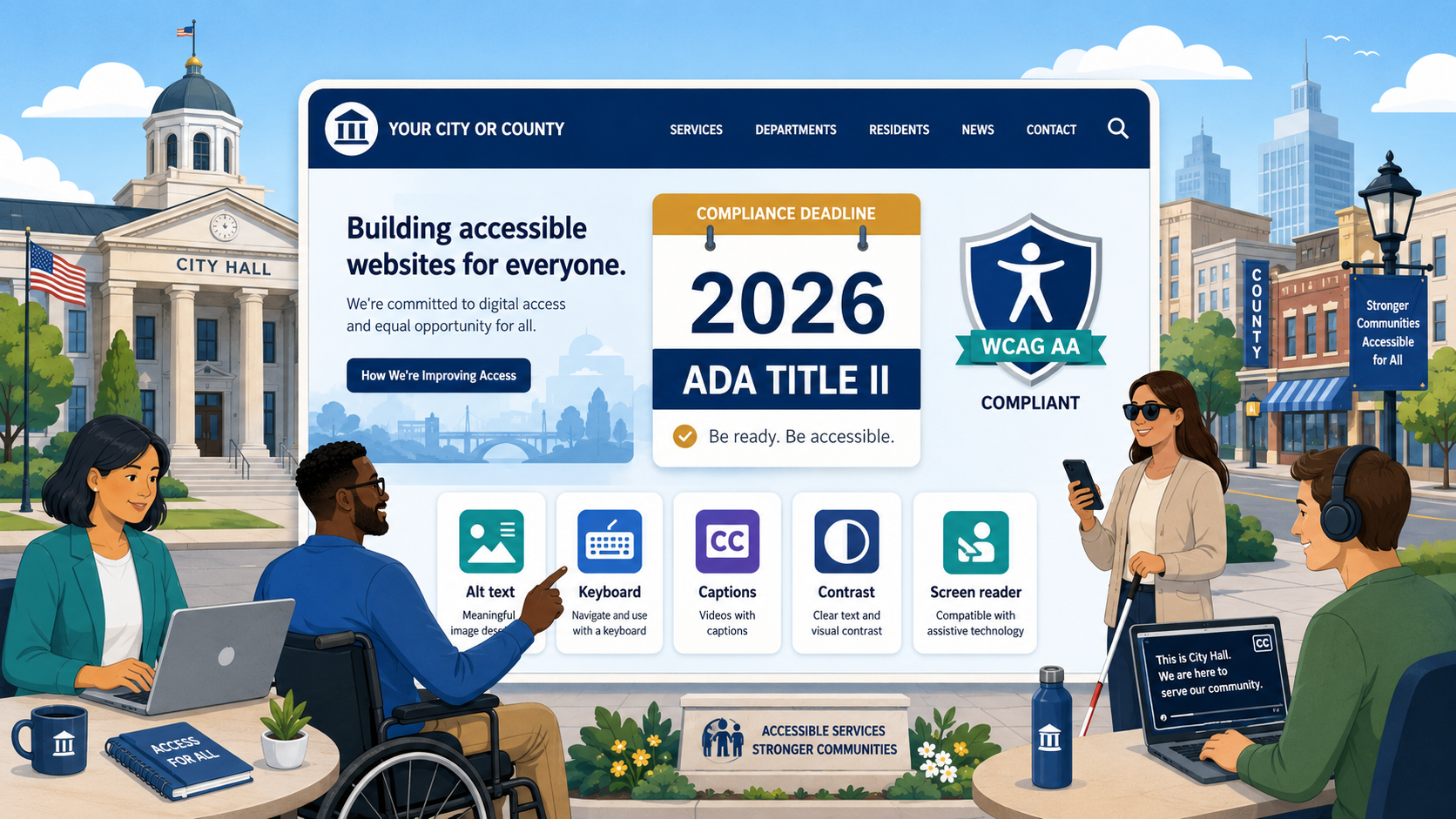
TL;DR: The DOJ’s April 2024 final rule requires state and local governments to meet WCAG 2.2 Level AA. Large entities (populations 50,000+) must comply by April 24, 2026. Smaller entities get until April 26, 2027. Non-compliance exposes agencies to DOJ complaints and private lawsuits. Start your audit now.
The Department of Justice ended years of regulatory ambiguity on April 24, 2024, when it published its final rule on web accessibility under Title II of the Americans with Disabilities Act (89 FR 31320). For the first time, state and local governments have a specific technical standard, a specific deadline, and no room to argue they didn’t know what was required. If your agency runs a public-facing website and serves a jurisdiction of 50,000 or more people, you have until April 24, 2026 — and that date is not moving.
What the DOJ Final Rule Actually Requires
The rule, published at 89 FR 31320 and codified at 28 C.F.R. Part 35, amends the existing ADA Title II regulations to add an explicit requirement for web and mobile accessibility. The technical standard is WCAG 2.2 Level AA — the Web Content Accessibility Guidelines version 2.2, published by the World Wide Web Consortium (W3C) on October 5, 2023.
Prior to this rule, ADA Title II already applied to government websites through the general non-discrimination requirements of 42 U.S.C. § 12132. What the 2024 rule does is remove all ambiguity about what standard satisfies that requirement. WCAG 2.2 Level AA is now the floor. Courts and the DOJ will measure compliance against that standard.
The rule was promulgated under the statutory authority of 42 U.S.C. § 12134, which grants the Attorney General authority to issue regulations implementing Title II. The DOJ’s Notice of Proposed Rulemaking had been pending since 2022, and the 2024 final rule incorporated public comments including input from disability advocacy organizations, state and local governments, and accessibility professionals.
Who Is Covered
ADA Title II covers all “public entities,” defined at 42 U.S.C. § 12131 as:
- Any state or local government
- Any department, agency, special purpose district, or other instrumentality of a state or local government
This is an extremely broad category. It includes:
- City and county governments and all their departments
- State agencies and departments
- Public school districts
- Public universities and community colleges
- Transit authorities, port authorities, water districts, and other special districts
- Courts, sheriffs’ offices, public hospitals, and libraries
If your organization is a unit of state or local government, ADA Title II applies to you. Federal agencies are governed by Section 508 of the Rehabilitation Act, not Title II — though many state agencies that receive federal funding are subject to both.
The rule applies to websites and mobile applications. It covers both web-based content and native mobile apps offered by covered entities.
The Two-Tier Deadline Structure
The DOJ established a two-tier compliance timeline based on the population of the jurisdiction served:
Tier 1 — Large entities (population of 50,000 or more): April 24, 2026
This applies to state governments and local governments serving populations at or above 50,000. The population figure refers to the population of the jurisdiction served, not the number of employees or users of the website. A city of 75,000 people must comply by April 24, 2026, even if its IT department has five people.
Tier 2 — Small entities (population under 50,000): April 26, 2027
Smaller local governments — small towns, rural counties, small special districts — have an additional year. This accommodates entities with limited resources and technical capacity.
The deadlines are calculated from the rule’s effective date. They are not extensions the DOJ is likely to grant simply because remediation is expensive or technically complex. The DOJ was explicit in the preamble that the timeline was calibrated to give covered entities adequate preparation time.
What WCAG 2.2 Level AA Means in Plain Language
WCAG 2.2 is organized around four principles: Perceivable, Operable, Understandable, and Robust. Level AA includes 50 success criteria — the specific requirements an agency must meet.
In practical terms, WCAG 2.2 Level AA requires your website to:
- Provide text alternatives for all non-text content, including images, charts, icons, and buttons. A photograph of a building permit form must have descriptive alt text.
- Caption all video content that is pre-recorded. Every training video, council meeting recording, and public notice video on your site needs accurate captions.
- Meet color contrast ratios of at least 4.5:1 for normal text and 3:1 for large text and user interface components. Many government websites fail this on navigation menus, form labels, and button text.
- Be fully operable by keyboard alone, without requiring a mouse or touch screen. This means a user navigating only with Tab, Enter, and arrow keys must be able to access every feature.
- Avoid keyboard traps where a user navigating by keyboard gets stuck in a component and cannot exit.
- Provide page titles that describe the topic or purpose of each page.
- Show visible focus indicators so keyboard users can see where they are on the page. WCAG 2.2 added enhanced requirements for focus appearance.
- Not require cognitive function tests for authentication — this is new in WCAG 2.2 (success criterion 3.3.8). Login processes cannot rely solely on puzzles or memorization unless an alternative is offered.
- Support text resize up to 200% without loss of content or functionality.
- Allow content reflow so pages remain usable at 400% zoom without horizontal scrolling.
See our WCAG 2.2 Level AA checklist for government websites for a full breakdown of all 50 success criteria and how to test each one.
WCAG 2.2 added several new success criteria beyond WCAG 2.1, including requirements around dragging movements (2.5.7 — alternatives for actions that require dragging), focus not obscured (2.4.11 — focused components must not be entirely hidden by sticky headers or other content), and accessible authentication (3.3.8).
Explicit Exemptions Under the Rule
The final rule carves out specific categories of content from the WCAG 2.2 requirement. Understanding these exemptions matters — but they are narrower than some agencies hope.
Archived content. Web content that was created before the compliance deadline, is kept only for reference or historical purposes, is not updated after the compliance date, and is stored in a dedicated archive section of the website. The key word is “archived” — content must be segregated from current operational content and clearly labeled. A PDF from 2015 that remains on a regularly updated department page is not archived content.
Preexisting conventional electronic documents. Word documents, PDFs, spreadsheets, and similar files that were created before the compliance deadline and are not currently used to apply for, gain access to, or participate in an agency’s services, programs, or activities. If a PDF form is actively used for permit applications, it is not exempt.
Content posted by third parties. Content that a third party posts to the agency’s website without the agency’s solicitation or control. This covers user-submitted comments in some contexts, but it does not cover content the agency contracts for or acquires.
Password-protected content created for a specific individual (not a class of individuals). This covers content like personalized account portals, not department intranets.
Linked third-party content. When an agency links to a third-party website, that external site’s accessibility is not the agency’s responsibility under this rule.
These exemptions are genuine but limited. They do not excuse agencies from remediating currently active content, forms, services, or anything created after the compliance deadline.
Consequences of Non-Compliance
ADA Title II enforcement operates through two primary channels:
Administrative complaints to the DOJ. Individuals can file complaints with the DOJ’s Civil Rights Division alleging violations of Title II, including web accessibility failures. The DOJ investigates and, when it finds violations, typically attempts to negotiate a voluntary compliance agreement. These agreements often require extensive remediation plans, third-party auditing, staff training, and periodic reporting to the DOJ. They are public documents and frequently cited as precedent in subsequent enforcement actions.
Private lawsuits under Title II. The ADA Title II creates a private right of action under 42 U.S.C. § 12133, incorporating the remedies of Section 505 of the Rehabilitation Act. Individuals and disability rights organizations can sue covered entities directly in federal court. Successful plaintiffs can obtain injunctive relief (a court order to fix the website) and attorneys’ fees. The number of federal accessibility lawsuits has grown substantially in recent years, and government entities are increasingly named defendants.
Consent agreements and corrective action plans. When the DOJ resolves complaints or litigation, it typically requires comprehensive consent agreements that include website audits, remediation timelines, staff training, procurement policy changes, and ongoing monitoring obligations. These agreements impose significant administrative burdens and, in some cases, require the entity to fund ongoing technical assistance.
The risk is not abstract. The DOJ has reached accessibility consent agreements with major cities, counties, and state agencies. With the 2026 deadline in place, litigation risk increases materially for any entity that has not made demonstrable progress.
What to Do Now
1. Commission a professional audit. Automated scanning tools catch roughly 30–40% of WCAG failures. Our government website compliance checklist covers every category — accessibility, security, privacy, and performance — in one place. A comprehensive audit combines automated tools with manual testing by accessibility professionals and actual users with disabilities. The audit should produce a prioritized list of failures mapped to specific WCAG success criteria.
2. Inventory your digital properties. Most agencies underestimate how many web properties they operate — department microsites, event calendars, permit portals, library catalogs, payment systems, meeting archive platforms. All of them are covered.
3. Prioritize by user impact. Not all failures are equal. Start with the pages and applications that serve the highest volume of users and the most critical government functions: permit applications, benefit enrollment, 311 systems, court portals, and public notices.
4. Fix new content first. While you remediate the backlog, establish processes to ensure all newly published content meets WCAG 2.2 AA. Stop the bleeding before draining the swamp.
5. Document your remediation work. Courts and the DOJ look for evidence of good-faith effort. Maintain records of your audit findings, remediation timelines, and progress milestones. This documentation matters if you face a complaint before remediation is complete.
6. Train content editors and developers. Accessibility failures recur if the people creating content do not understand what is required. Training is not optional — it is the only way to maintain compliance after an initial remediation effort.
7. Address your PDF library. Government agencies publish enormous quantities of PDFs. Actively used forms and documents must be remediated or replaced with accessible HTML alternatives. This is often the most labor-intensive part of compliance work.
8. Evaluate your procurement and vendor contracts. Third-party systems — permit software, payment processors, ADA complaint portals — must also be accessible. Review vendor accessibility conformance reports (VPATs) and include accessibility requirements in new contracts.
The April 24, 2026 deadline is roughly a year away as of this writing. For most government agencies with substantial web presences, that is not much time. The agencies that will meet the deadline are the ones that started serious remediation work in 2024 and 2025 — not the ones waiting to see if the rule will be enforced.
Govzu provides continuous web accessibility monitoring specifically built for government websites, helping agencies track WCAG 2.2 compliance across their full web presence and document remediation progress over time. Learn more at govzu.com.