
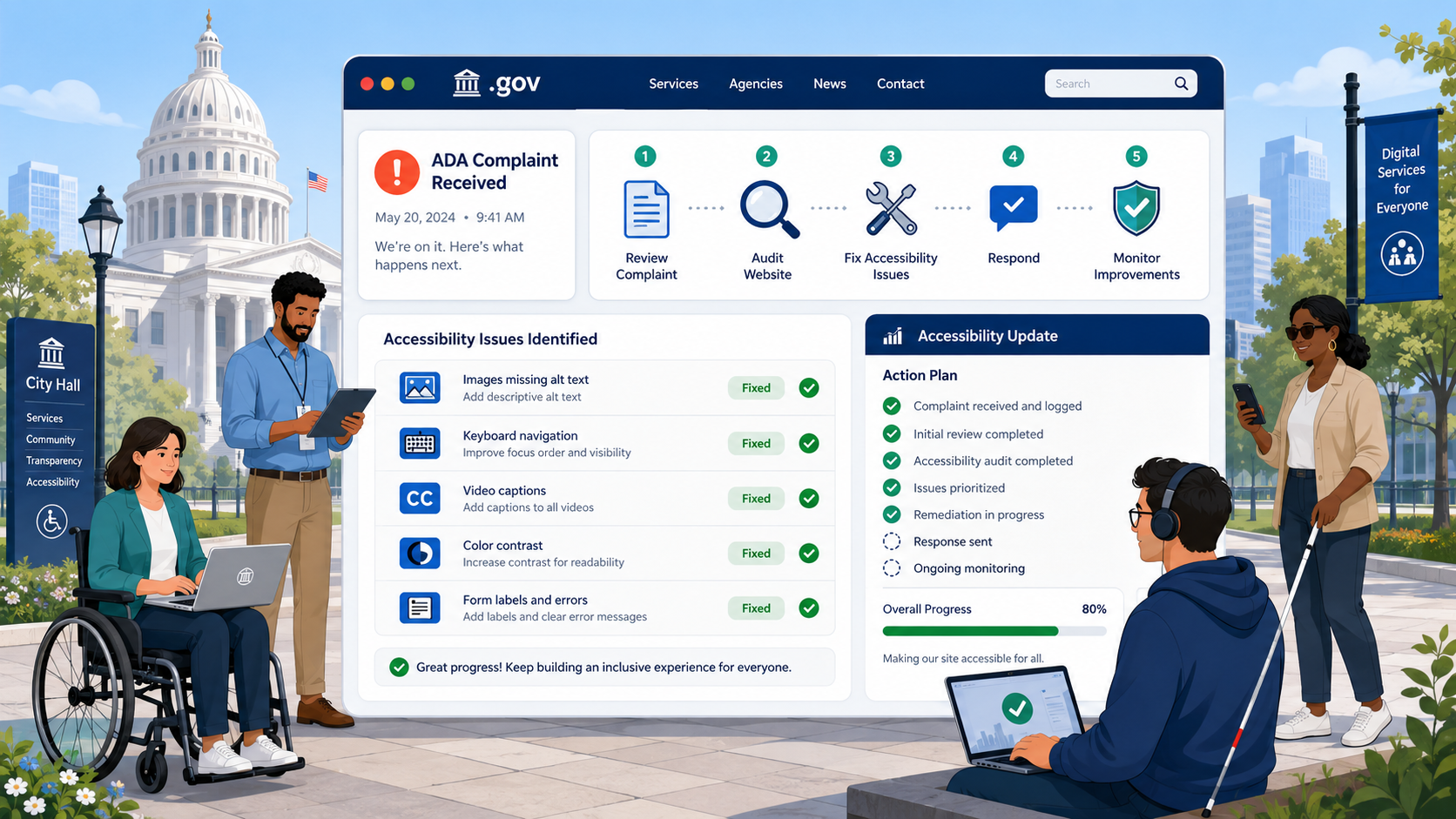
TL;DR: A Title II web accessibility complaint generally moves through five stages: complaint filed, intake and assignment, investigation, letter of findings, and resolution agreement. The DOJ and federal funding agencies rarely litigate — they negotiate. Agencies that have a documented accessibility program before the complaint arrives end up with much narrower agreements than agencies that do not.
The DOJ’s 2024 ADA Title II final rule does not change the complaint process. It changes what an agency can be found liable for. Starting April 24, 2026 for entities with 50,000 or more residents, “we did not know our website had to be accessible” is no longer a defense, and “we are working on it” without a documented program is no longer enough. This article walks through what actually happens when a complaint lands, drawing on the pattern of resolution agreements DOJ and the federal Offices for Civil Rights have published over the last decade.
Where Complaints Come From
A Title II web accessibility complaint can be filed by anyone, not just a person directly affected. Complaints typically originate from one of four sources:
- An individual member of the public who encountered a barrier (the most common)
- A disability advocacy organization that has identified the agency as a target
- A plaintiff’s law firm conducting systematic testing across many agencies
- A federal funding agency’s own compliance review (proactive, not complaint-driven)
The agency cited in the complaint may not even know it has been filed for several weeks. The federal investigator does not call to give a heads up.
Where Complaints Are Filed
Web accessibility complaints under Title II can be filed with multiple federal entities. The forum depends on the agency and the program:
- The US Department of Justice Civil Rights Division — has jurisdiction over Title II generally and has been the lead enforcer of the 2024 web accessibility rule.
- The Department of Education’s Office for Civil Rights — handles complaints involving public schools, colleges, and universities under both Title II and Section 504. OCR has been the most active web accessibility enforcer in the country for the last decade; see our coverage of OCR enforcement in higher education.
- The Department of Health and Human Services’ Office for Civil Rights — handles complaints involving programs that receive HHS funding (state Medicaid sites, health departments).
- Other federal funding agencies — HUD, DOT, USDA, and others handle complaints in their program areas.
Complainants can also file directly in federal court under Title II’s private right of action. Court cases are less common than administrative complaints but the volume is rising.
Stage 1: Intake
After the complaint is filed, the receiving agency assesses jurisdiction and timeliness. Title II complaints must generally be filed within 180 days of the alleged discrimination, though there is some flexibility for continuing violations (a permanently inaccessible page can be a continuing violation).
If the agency accepts the complaint, it sends written notice to the public entity named in the complaint. This notice:
- Identifies the complainant (sometimes anonymized)
- Summarizes the alleged barriers
- Requests an initial response within a set period (typically 30 days)
- Requests specific documentation
The documentation request usually includes:
- The agency’s accessibility statement
- The agency’s accessibility policy and procedures
- The agency’s ADA Coordinator designation
- The agency’s grievance procedure
- Training records for staff involved in web content
- Any prior accessibility audits or remediation plans
- Procurement records for web platforms and tools
- Logs of accessibility-related public feedback
An agency that cannot produce these documents has already established a weak negotiating position before the investigation begins.
Stage 2: Investigation
The investigating agency conducts its own testing. This typically involves:
- Automated scanning of a sample of the agency’s pages
- Manual review of the specific pages cited in the complaint
- Assistive technology testing of key workflows
- Review of PDFs and other documents linked from the cited pages
- Interviews with the ADA Coordinator and IT staff
- Review of public-facing communications about accessibility
Investigations have ranged from a few weeks to several years. Web accessibility investigations against universities and large state agencies have averaged 18 to 30 months. Investigations under the new DOJ rule are expected to move faster because the standard is now bright-line.
During the investigation, the agency has the opportunity to provide additional information and to begin voluntary remediation. Voluntary remediation does not stop the investigation but is consistently weighted favorably in the eventual resolution.
Stage 3: Letter of Findings
At the conclusion of the investigation, the federal agency issues findings. These can take several forms:
- No violation found — relatively rare in web accessibility cases that proceed past intake
- Violation found, voluntary compliance offered — the most common path
- Violation found, formal enforcement action — referral to DOJ for litigation under Title II, or program funding consequences
The letter of findings identifies the specific WCAG criteria the federal agency considers violated, the pages and content involved, and the public entity’s obligations.
Letters of findings are typically published, often with the agency name. They become part of the public record of OCR and DOJ enforcement. Future complainants and plaintiffs’ attorneys reference them. Future agencies under investigation reference them to anticipate likely outcomes.
Stage 4: Resolution Agreement
The resolution agreement is the negotiated settlement. The agency agrees to specific remedies in exchange for closure of the complaint without formal enforcement. Across the last decade of web accessibility resolution agreements, the same elements appear consistently:
Remediation Commitments
- Bring the website into conformance with WCAG 2.1 Level AA (now the floor under the DOJ rule) by a defined date
- Remediate specific cited pages by an earlier date (typically 90 to 180 days)
- Address PDFs and other documents on a documented timeline, often prioritized by traffic
Governance Commitments
- Designate or reaffirm an ADA Coordinator
- Adopt or update an accessibility policy
- Publish or revise the accessibility statement
- Establish a grievance procedure for accessibility complaints
Training Commitments
- Train all staff who create or publish web content
- Train staff who procure software and digital services
- Train developers and IT staff in WCAG implementation
Procurement Commitments
- Adopt accessibility requirements for IT procurement
- Require and evaluate VPATs for new procurements (see our VPAT guide)
- Audit existing third-party tools and replace or remediate non-conforming ones
Monitoring Commitments
- Conduct periodic accessibility audits (typically annual)
- Implement automated monitoring
- Report progress to the federal agency on a defined schedule (often quarterly for the first year)
Reporting
- Submit periodic compliance reports to the federal agency for the duration of the agreement (typically two to four years)
- Provide a complaint log and remediation log
- Allow on-site or remote follow-up review
Resolution agreements are enforceable. An agency that fails to comply faces reopening of the investigation and potential referral to DOJ for litigation, with the resolution agreement itself as additional evidence of bad faith.
Stage 5: Monitoring Period
After the agreement is signed, the federal agency monitors compliance. This typically lasts two to four years. During this period the agency:
- Files the required reports
- Responds to follow-up questions
- Allows requested testing
- Addresses any new complaints under the framework of the existing agreement
A clean monitoring period closes the matter. A monitoring period with new findings extends the agreement and can lead to additional obligations.
What Settlements Cost
Resolution agreements under Title II web accessibility complaints generally do not include monetary damages to complainants — Title II authorizes injunctive relief, not damages, for individual complainants in most circumstances. The cost to the agency comes from:
- The remediation work itself (often hundreds of thousands of dollars for a large site)
- The ongoing monitoring and reporting burden
- The procurement of accessibility tools and training
- Staff time across IT, communications, ADA coordination, legal, and content teams
- Reputational cost from publication of findings
Plaintiffs’ lawsuits filed directly in federal court can include attorney’s fees and, under state laws that incorporate Title II by reference (notably California’s Unruh Civil Rights Act), statutory damages. These cases routinely settle for tens of thousands of dollars per agency, sometimes more.
Notable Patterns
A few patterns emerge consistently across resolution agreements:
- PDFs and documents are always cited. Agencies that have not addressed PDF accessibility are categorically out of compliance.
- Third-party content is not a shield. Agencies are required to address embedded tools, vendor-hosted portals, and external content their site presents.
- The accessibility statement is always reviewed. A missing or stale statement is treated as evidence of programmatic failure.
- Training is always required. Agencies that cannot demonstrate ongoing staff training receive the most prescriptive training mandates.
- Audits are always required. A documented annual audit program is expected.
How to Reduce Risk Before a Complaint Arrives
The single largest determinant of how an investigation goes is what the agency can show on day one. Agencies that respond to the initial documentation request with:
- A published, current accessibility statement
- An active ADA Coordinator with documented training
- A documented accessibility policy and grievance procedure
- A recent third-party accessibility audit
- A continuous monitoring report
- Procurement records showing VPAT review
- Training records for content staff
— consistently end up with narrower agreements, shorter monitoring periods, and smaller remediation obligations than agencies that respond with “we’ll have to look into that.” See our ADA Title II 2026 deadline guide for local government and the parallel state government obligations guide for what a defensible program looks like by entity type.
How Govzu Helps
Govzu produces the evidence base agencies need on the day a complaint arrives. Continuous WCAG 2.1 and 2.2 monitoring across every page, automated tracking of remediation work over time, third-party component inventory, and a timestamped record of accessibility state combine to demonstrate that the agency had a real program in place — not a reactive scramble. When a federal investigator requests “all evidence of accessibility testing and remediation for the last two years,” Govzu makes that response a query, not a fire drill.