
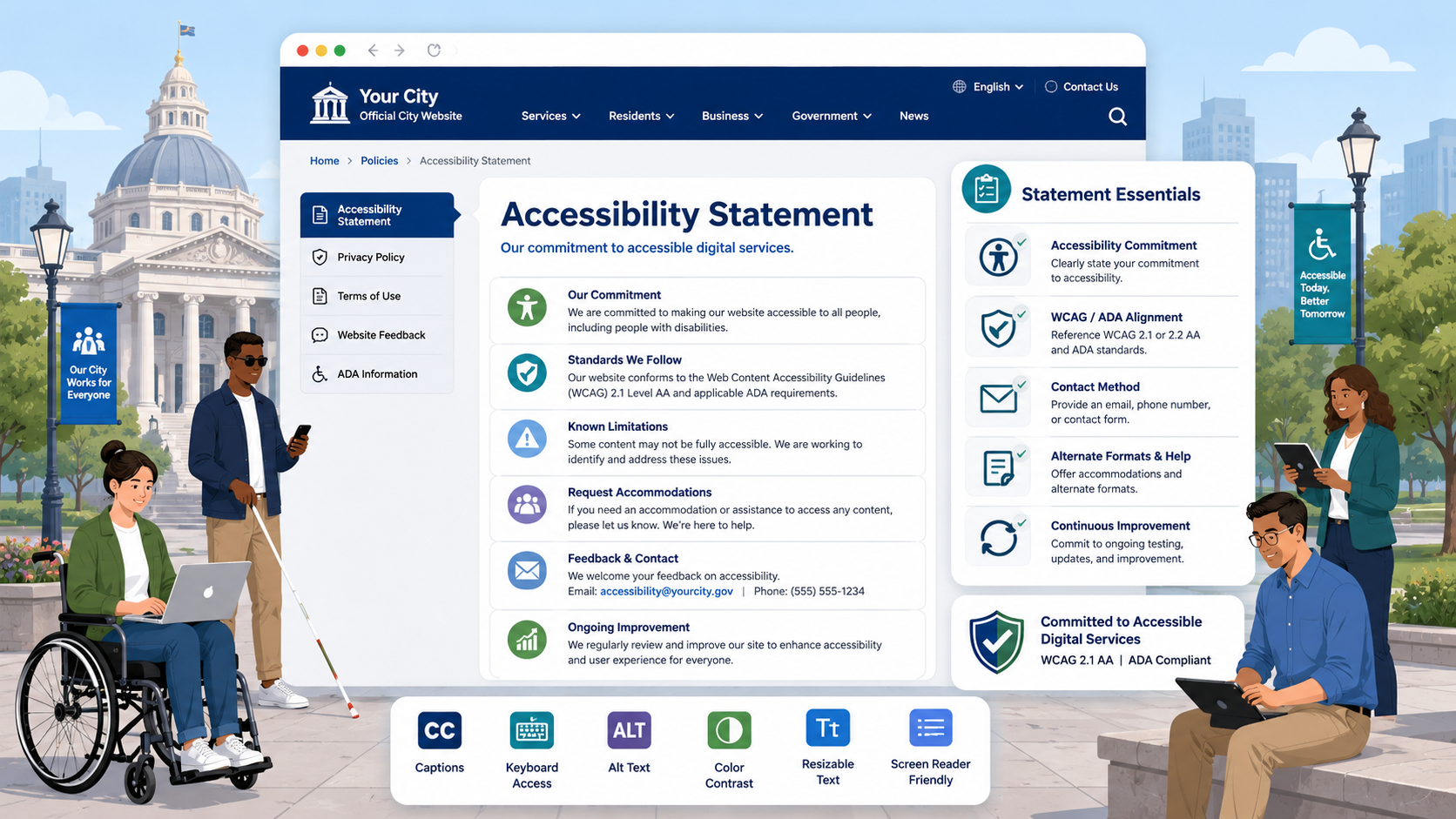
TL;DR: Under the DOJ’s 2024 ADA Title II final rule, state and local governments are expected to publish an accessibility statement that names the standard targeted (WCAG 2.1 Level AA), discloses known limitations, and provides a working feedback mechanism. A good statement is short, honest, and current. A bad one is a legal liability.
An accessibility statement is the public-facing document that tells visitors what your agency has done to make its website usable for people with disabilities, what it has not yet done, and how to ask for help or file a complaint. Under the DOJ’s 2024 final rule implementing ADA Title II, this is no longer optional best practice — it is the baseline expectation regulators and plaintiffs’ attorneys look for first when they evaluate whether an agency is taking accessibility seriously.
This guide walks through what an accessibility statement must include, what it should never include, and how to keep it accurate as your site evolves.
Why an Accessibility Statement Matters
The DOJ final rule itself does not include a line that says “you must publish an accessibility statement.” What it does require is that public entities make their web content conform to WCAG 2.1 Level AA by April 24, 2026 (for entities with 50,000 or more residents) or April 26, 2027 (for smaller entities and special district governments). The accessibility statement is the mechanism by which agencies demonstrate three things that the rule, related Section 504 regulations, and decades of OCR enforcement actions consistently require:
- A documented commitment to a specific technical standard
- A way for users to report barriers
- A non-discriminatory grievance procedure
When the Department of Justice or the Department of Education’s Office for Civil Rights opens an investigation, the accessibility statement is one of the first artifacts they ask for. Its absence is treated as evidence that the agency has no compliance program at all.
What Your Accessibility Statement Must Include
There is no federally mandated template, but a defensible statement contains the following elements. Each is drawn from the structure used in OCR resolution agreements and the European EN 301 549 model statement that many US agencies have adopted.
1. A Clear Conformance Target
State the exact standard and conformance level. For most US state and local government sites under the new rule, this will be:
“This website is designed to conform to the Web Content Accessibility Guidelines (WCAG) 2.1, Level AA, published by the World Wide Web Consortium.”
If your agency has decided to target WCAG 2.2 Level AA — which is permitted and increasingly recommended because 2.2 is backward compatible with 2.1 — say so explicitly. Federal agencies subject to Section 508 should reference the Revised 508 Standards, which incorporate WCAG 2.0 Level AA by reference; see our Section 508 vs. ADA Title II comparison for context.
2. A Conformance Claim
Use one of three honest formulations:
- Fully conforms — every page and every piece of content meets the standard. Almost no real government website qualifies.
- Partially conforms — most content meets the standard, but some does not. This is the realistic claim for most agencies in 2026.
- Does not yet conform — the agency is actively working toward conformance. Appropriate if remediation is in progress and the deadline has not arrived.
Do not write “we strive to conform” or “we are committed to accessibility.” Those phrases mean nothing in an enforcement context.
3. Known Limitations
Disclose the specific content types or pages that you know do not conform. An accessibility audit is the right way to identify these systematically. Examples regulators expect to see honestly listed:
- Legacy PDFs scanned before a certain date
- Third-party embedded content (maps, payment portals, video players)
- User-generated content in public comment systems
- Content from external vendors not yet updated to meet your standard
Listing limitations is not an admission of liability — it is evidence of an active program. Hiding them is what creates liability.
4. A Feedback Mechanism
Provide at least two ways for users to report accessibility barriers: an email address and a phone number. Many agencies also include a web form, but the form itself must be accessible. State a target response time. A common commitment is “we will respond within two business days and provide accessible alternatives within ten business days.”
This feedback channel must be staffed. OCR resolution agreements have repeatedly required agencies to demonstrate that someone is actually monitoring the inbox.
5. Enforcement and Complaint Process
ADA Title II requires public entities with 50 or more employees to designate an ADA Coordinator and adopt a grievance procedure. Your accessibility statement should name the ADA Coordinator (by title, at minimum) and link to or summarize the grievance procedure. It should also tell users they have the right to file a complaint with:
- The US Department of Justice Civil Rights Division
- The relevant federal funding agency’s Office for Civil Rights (most commonly ED or HHS for state and local government programs)
Do not try to discourage external complaints. Statements that say “please contact us first before filing a complaint” have been cited by OCR as deterring protected activity.
6. The Date the Statement Was Last Reviewed
A statement dated 2019 on a 2026 website is worse than no statement at all. Include “Last reviewed: [date]” and update it at least annually, or whenever a material change occurs.
A Template You Can Adapt
The following template is a practical starting point. Replace bracketed items with your agency’s information.
Accessibility Statement for [Agency Name]
[Agency Name] is committed to ensuring that its website is accessible to people with disabilities. We are working to conform to the Web Content Accessibility Guidelines (WCAG) 2.1, Level AA, as required by the US Department of Justice’s regulations implementing Title II of the Americans with Disabilities Act.
Conformance status. This website is partially conformant with WCAG 2.1 Level AA. “Partially conformant” means that some parts of the content do not fully conform to the accessibility standard.
Known limitations. Despite our best efforts, users may encounter the following issues:
- PDF documents published before January 2024 may not be fully accessible. We are remediating these documents on a rolling basis and will provide accessible versions on request.
- The third-party online payment portal at [URL] is operated by [vendor] and is the subject of a separate accessibility remediation effort.
- Live video streams of public meetings include captions; archived recordings are captioned within five business days.
Feedback. If you encounter an accessibility barrier on this website, or if you need information in an alternate format, please contact:
- Email: accessibility@[agency].gov
- Phone: [number] (TTY: 711)
- Mail: [address]
We aim to respond to accessibility feedback within two business days and to provide the requested information in an accessible format within ten business days.
ADA Coordinator and grievance procedure. [Agency Name]’s ADA Coordinator is the [title]. You may file a grievance under our ADA grievance procedure, available at [URL]. You also have the right to file a complaint with the US Department of Justice or with the federal agency that provides funding to the program at issue.
Formal approval. This statement was prepared on [date] and last reviewed on [date]. It was approved by [name or title].
What Not to Include
Several common additions weaken a statement or create legal exposure:
- Vague aspirational language. “We strive to provide an exceptional experience for all users” is marketing copy, not a conformance claim.
- Disclaimers of liability. “We are not responsible for content on linked sites” is fine; “we make no warranty regarding accessibility” is not.
- Requirements that users disclose their disability. You cannot condition accommodation on disclosure of a specific diagnosis.
- Requirements that users use a specific browser or assistive technology. WCAG conformance is technology agnostic.
- References to overlay widgets as a compliance solution. Accessibility overlays have been the subject of multiple FTC and plaintiff actions; citing one in your statement signals that your agency does not understand the rule.
Keeping the Statement Current
The accessibility statement is a living document. Establish a quarterly review cadence and a trigger-based review when any of the following occurs:
- A new website, subdomain, or major application is launched
- A new third-party tool is procured
- The WCAG version targeted by your agency changes
- A complaint, finding, or settlement agreement requires a change
- An ADA Coordinator change occurs
Many agencies build the accessibility statement review into the same governance cycle as their government website compliance checklist and privacy policy review.
Where to Publish It
The statement should be linked from the global footer of every page on your website, using the link text “Accessibility” or “Accessibility Statement.” Burying it in an About section or making it reachable only from the homepage has been cited as a barrier in OCR findings. If your agency operates multiple websites or subdomains, each one needs either its own statement or a clearly scoped statement that names every covered property.
Common Mistakes That Trigger Findings
Across OCR and DOJ enforcement actions of the last decade, the same accessibility statement defects appear repeatedly:
- The page exists but is not linked from the footer
- The standard cited is WCAG 2.0 Level A (insufficient under the new rule)
- The feedback email bounces or is unmonitored
- The ADA Coordinator named has not worked at the agency for years
- The statement was last reviewed before the agency’s last major redesign
- The page itself fails WCAG (low color contrast, missing heading structure, missing alt text on the agency logo)
Each of these is a small fix that prevents a much larger problem.
How Govzu Helps
Govzu continuously monitors your accessibility statement and the pages it covers, alerting your team when the statement page itself develops WCAG issues, when the feedback email starts bouncing, when the link disappears from the global footer, or when the statement has not been reviewed within your agency’s defined cadence. Combined with full-site WCAG 2.1 and 2.2 conformance scanning, Govzu gives ADA Coordinators the evidence base they need to keep their accessibility statement accurate as the April 2026 deadline approaches and beyond.