
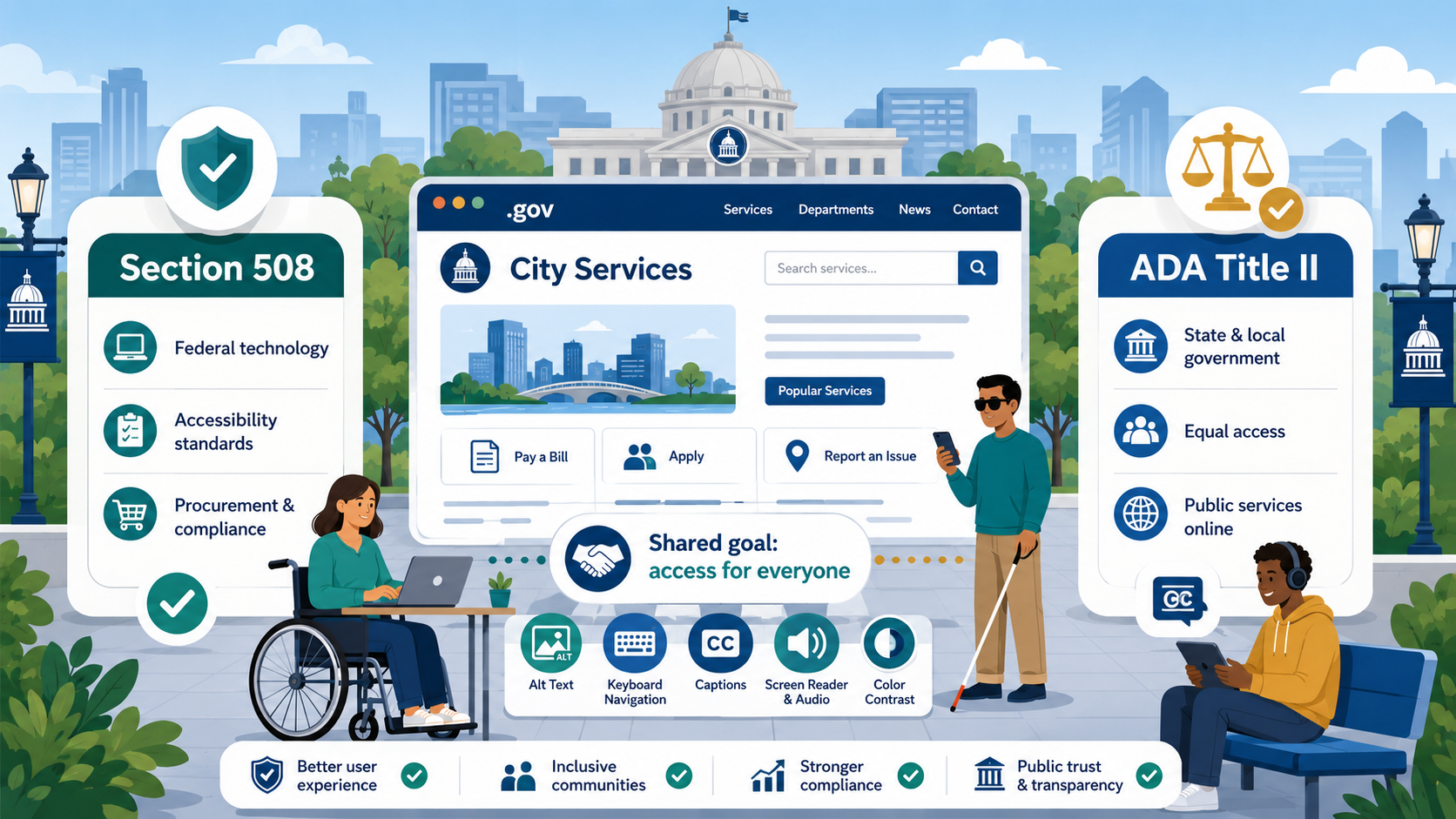
TL;DR: Section 508 covers federal agencies and federally funded programs. ADA Title II covers all state and local governments regardless of federal funding. They reference different versions of WCAG — 508 uses WCAG 2.0 AA, Title II now requires WCAG 2.2 AA. If you run a state or local government website, you likely face both. Aim for WCAG 2.2 AA and you satisfy both.
If you manage a web presence for a government agency, you have almost certainly heard both “Section 508” and “ADA Title II” cited as the legal basis for web accessibility requirements. Compliance attorneys, accessibility consultants, and auditors use these terms interchangeably in some contexts and as distinct frameworks in others. The distinction is not academic — the two laws have different scopes, different technical standards, and different enforcement mechanisms. Understanding which one applies to your agency determines what you are legally required to do, by when, and what happens if you do not.
Section 508 of the Rehabilitation Act: Federal Agencies and Federal Money
Section 508 was added to the Rehabilitation Act of 1973 (29 U.S.C. § 794d) by the Workforce Investment Act of 1998 and significantly strengthened by the Rehabilitation Act Amendments. It requires that federal agencies ensure their electronic and information technology is accessible to people with disabilities — both employees and members of the public.
The governing technical standard is the Revised 508 Standards, published by the U.S. Access Board on January 18, 2017, and effective March 23, 2018 (82 FR 5790). The Revised 508 Standards formally incorporate WCAG 2.0 Level AA by reference. This is an important technical detail: Section 508 requires WCAG 2.0 AA, not WCAG 2.1 or 2.2.
Who Section 508 Covers
The statute applies to federal agencies — the executive branch departments, independent regulatory agencies, and other entities of the federal government. (Federal agencies are also subject to the 21st Century IDEA Act for broader website modernization requirements.) The standard applies to:
- All electronic and information technology developed, procured, maintained, or used by a federal agency
- This includes websites, web applications, software, hardware, multimedia, and telecommunications products
Section 508 also extends to federal contractors and grantees through the conditions attached to federal funding. When a state agency, university, or nonprofit receives federal financial assistance and uses that assistance to develop or procure technology, Section 508 requirements flow through as contract conditions. This is the mechanism by which Section 508 reaches beyond federal agencies themselves.
However, this reach is conditional. A state agency’s internal technology that is funded entirely with state appropriations — no federal dollars involved — is not covered by Section 508. The reach of Section 508 follows the federal money.
Section 508 Enforcement
The enforcement structure under Section 508 is primarily administrative:
- Individuals with disabilities who are federal employees or who are trying to access federal agency technology can file administrative complaints with the relevant federal agency’s Section 508 program.
- Complaints can also be filed with the DOJ, which has oversight responsibility.
- If administrative remedies are exhausted, individuals may file civil actions in federal court.
- The Government Accountability Office (GAO) and agency inspectors general conduct periodic assessments of agency compliance.
Section 508 does not create a straightforward private right of action in the same way the ADA does. Litigation under Section 508 is less common than ADA litigation, though it does occur.
ADA Title II: All State and Local Government, Period
Title II of the Americans with Disabilities Act (42 U.S.C. §§ 12131–12165) prohibits discrimination on the basis of disability by “public entities.” Public entities are state and local governments — all of them, in all their forms, regardless of whether they receive federal funding.
The general non-discrimination mandate of Title II has applied to government websites since the statute was enacted in 1990. What changed in 2024 is that the DOJ issued a final rule (89 FR 31320, published April 24, 2024) that specifies the technical standard: WCAG 2.2 Level AA.
Who ADA Title II Covers
Every state and local government entity. This is not limited to:
- Entities receiving federal grants
- Entities of a certain size (though the compliance deadline timeline varies by population)
- Entities with a certain number of employees
If your organization is a unit of state or local government — a city, county, township, state agency, school district, transit authority, port authority, public library, state court, or any other instrumentality of state or local government — ADA Title II applies to you. No federal funding required.
The Technical Standard: WCAG 2.2 AA, Not 2.0
This is where the practical divergence between Section 508 and ADA Title II becomes most significant for web teams.
Section 508 currently requires WCAG 2.0 Level AA. The Access Board has indicated it intends to update the Revised 508 Standards to incorporate WCAG 2.1 or 2.2, but as of this writing, the formal standard remains WCAG 2.0 AA.
ADA Title II, under the 2024 final rule, requires WCAG 2.2 Level AA.
WCAG 2.2 includes all of WCAG 2.0 and 2.1, plus additional success criteria:
- 2.4.11 Focus Not Obscured (Minimum) — ensures focused components are not entirely hidden by sticky navigation or other overlaid content
- 2.4.12 Focus Not Obscured (Enhanced) — requires full visibility of focused components (AAA, not required by the DOJ rule)
- 2.4.13 Focus Appearance — enhanced requirements for focus indicator size and contrast (AAA)
- 2.5.7 Dragging Movements — requires alternatives for drag-based interactions
- 2.5.8 Target Size (Minimum) — minimum 24x24 CSS pixel pointer targets
- 3.2.6 Consistent Help — help mechanisms must appear in consistent locations (AAA)
- 3.3.7 Redundant Entry — previously entered information must not need to be re-entered within the same process
- 3.3.8 Accessible Authentication (Minimum) — eliminates cognitive function tests from authentication flows
- 3.3.9 Accessible Authentication (Enhanced) — expanded authentication requirements (AAA)
In practice, the gap between WCAG 2.0 and 2.2 is not enormous for most websites, but the new criteria — particularly accessible authentication and focus not obscured — address real accessibility barriers and have architectural implications for some systems.
ADA Title II Enforcement
Title II enforcement is more robust and more litigated than Section 508:
- DOJ administrative complaints. Individuals can file complaints with the DOJ’s Civil Rights Division. The DOJ investigates, and when it finds systemic violations, typically negotiates consent agreements that require comprehensive remediation, third-party monitoring, and ongoing reporting.
- Private right of action. 42 U.S.C. § 12133 incorporates the remedies of Section 505 of the Rehabilitation Act (29 U.S.C. § 794a), which creates a private cause of action. Individuals and organizations can sue state and local governments directly in federal court.
- Injunctive relief and attorneys’ fees. Successful plaintiffs can obtain court orders requiring remediation and recover their legal fees. This makes accessibility litigation economically viable for plaintiffs’ firms specializing in disability rights.
The volume of ADA web accessibility litigation has increased substantially over the past several years. State and local governments — particularly those with high-traffic websites or those that have publicly advertised compliance failures — are increasingly named defendants.
How They Overlap and Where They Diverge
| Dimension | Section 508 | ADA Title II |
|---|---|---|
| Primary coverage | Federal agencies | State and local governments |
| Extension to others | Federal contractors and grantees (via funding conditions) | None — coverage is based on entity type, not funding |
| Technical standard | WCAG 2.0 Level AA (Revised 508 Standards, 2018) | WCAG 2.2 Level AA (DOJ final rule, 2024) |
| Enforcement | Administrative complaints; limited private action | DOJ; private right of action in federal court |
| Deadline | No new deadline (Revised 508 Standards effective 2018) | April 24, 2026 (large entities); April 26, 2027 (small) |
For a state agency that receives federal grants, both frameworks apply simultaneously. The agency must comply with Section 508 with respect to the federally funded technology it develops and procures, and it must comply with ADA Title II with respect to its public-facing web presence broadly.
The practical consequence: since WCAG 2.2 AA is a superset of WCAG 2.0 AA, an agency that achieves WCAG 2.2 AA compliance satisfies both the ADA Title II requirement and the Section 508 requirement. There is no reason to target WCAG 2.0 AA for Section 508 purposes and stop there — doing so leaves you non-compliant with ADA Title II, which carries the greater litigation risk.
What About Section 504?
Section 504 of the Rehabilitation Act (29 U.S.C. § 794) prohibits discrimination on the basis of disability in programs and activities receiving federal financial assistance. Unlike Section 508, which focuses on technology procurement, Section 504 is a general non-discrimination mandate.
Section 504 applies to state and local governments that receive federal funding — through the same mechanism by which Title VI of the Civil Rights Act and Title IX of the Education Amendments apply. When a state or local government receives federal financial assistance, it accepts Section 504 obligations as a condition of that funding.
Section 504 does not specify a technical web standard in the same way the DOJ’s Title II rule does. However, federal agencies — including the Department of Education and HHS — have issued guidance applying Section 504 to web accessibility and have enforced Section 504 obligations in web accessibility resolution agreements.
For state and local governments, Section 504 effectively reinforces Title II obligations. If you have both Title II obligations (which you do, regardless of federal funding) and Section 504 obligations (which you likely do, because you receive federal funding), they point in the same direction: WCAG 2.2 AA.
What About Higher Education?
Public colleges and universities are state and local government entities, so they are covered by ADA Title II. They are typically not covered by Section 508 directly — that statute applies to federal agencies, not educational institutions.
However, public universities almost universally receive federal financial assistance — through student financial aid, research grants, and other programs. This makes them subject to Section 504 through their funding relationships with the Department of Education and other federal agencies.
Private universities are not covered by ADA Title II (that statute applies to public entities), but they are covered by Title III of the ADA (public accommodations), which has its own accessibility requirements for places of public accommodation. Private universities receiving federal funding are also subject to Section 504.
The DOJ’s 2024 Title II rule does not apply to private institutions, but the Department of Education has applied WCAG accessibility requirements to higher education institutions through Section 504 resolution agreements. For a detailed look at how OCR web accessibility complaints against universities work and what institutions face, see our dedicated guide.
The Practical Takeaway
If you manage web properties for a state or local government agency, the answer to “which standard applies to me?” is:
- ADA Title II applies to you, requiring WCAG 2.2 AA by your deadline.
- If you receive federal funding, Section 504 and likely Section 508 also apply, both pointing to WCAG 2.0 AA at a minimum.
- Target WCAG 2.2 AA and you satisfy all of them.
Do not waste time parsing the differences between WCAG 2.0, 2.1, and 2.2 to find the minimum standard you can legally claim satisfies each framework. The litigation risk, the enforcement environment, and the genuine accessibility need all point to the same place: WCAG 2.2 Level AA, fully implemented and continuously maintained. Use our WCAG 2.2 Level AA checklist for government websites as your practical testing guide.
Govzu monitors government websites against WCAG 2.2 Level AA, giving agencies continuous visibility into their compliance status under both ADA Title II and Section 508 frameworks. Learn more at govzu.com.